
Building for What Comes Next: STACK Conference 2026 Speaker Share His Perspective
19 October 2026
Category
Tech for Public Good
Digital Government
Learn how Mike Sutcliff, STACK 2026 keynote speaker, approaches AI adoption, from building “living systems” to deciding what to automate and what to leave to human judgment.
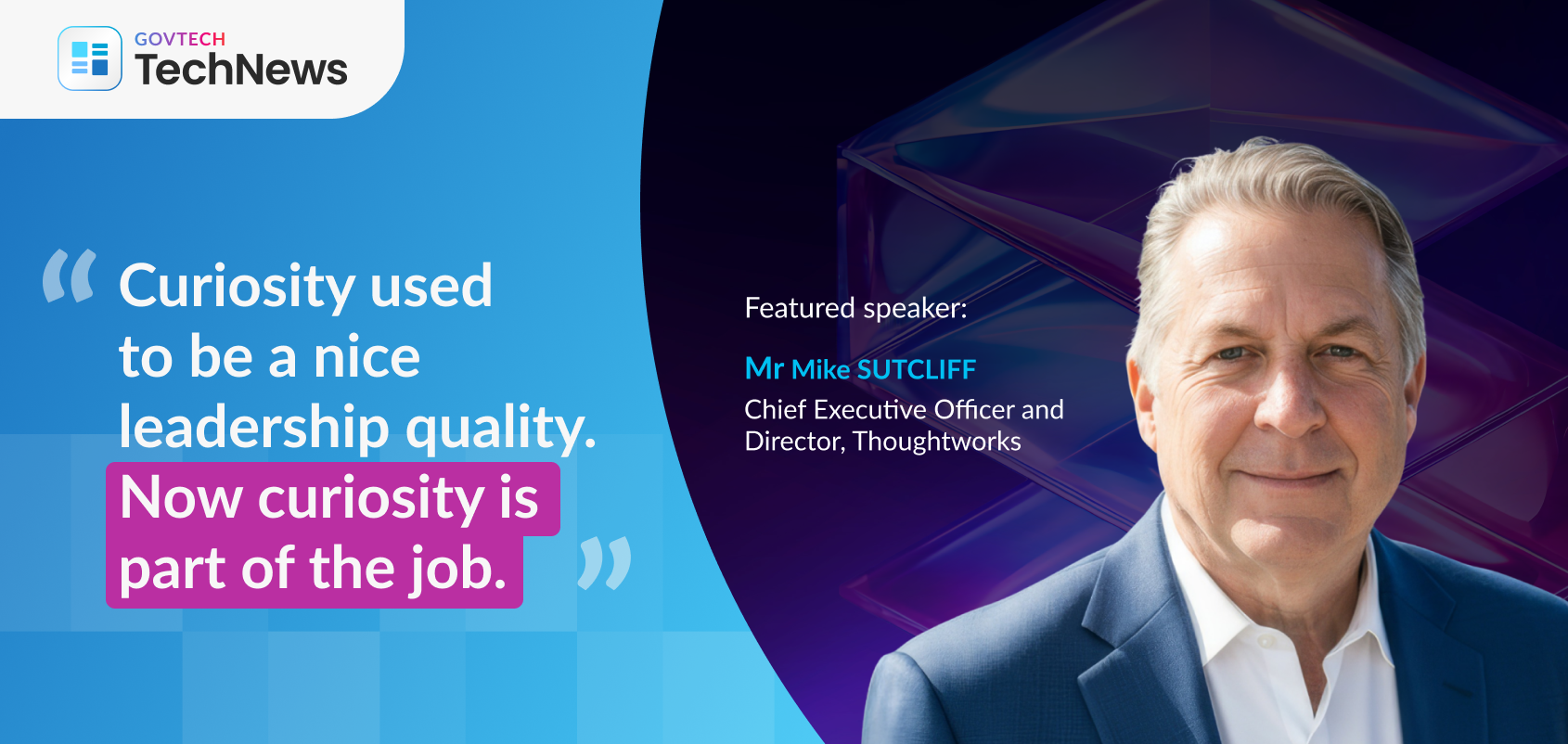
Mike Sutcliff, CEO and Director of Thoughtworks (opens in new tab), will be joining us at STACK Conference 2026 as a keynote speaker. Most organisations have added an AI tool or two and called it transformation. Mike thinks that's exactly the wrong move and he'll be making the case in his keynote, "Engineering Excellence in the AI Era." Ahead of his talk, he sat down with us to share the ideas he'll be exploring: how leaders can respond to rapid technological change, and how to help teams build well.
Having experienced several waves of technological change, what is different this time in the technology itself, or in how leaders have to respond to it?
We’ve lived through mainframe to PC, PC to internet, internet to mobile, and mobile to cloud. This one actually is different, and I think it’s different in three ways.
First, every prior wave automated tasks that already existed. This one is generative. AI produces things that didn’t exist before: code, analysis, creative work, strategy. That changes the productivity question, because the constraint isn’t throughput anymore. It’s judgment.
Second, it lands directly on knowledge work without a translation layer. AI works with language and reasoning, so every professional in every function is now in the path of this change. The opportunity belongs to everyone, not just the technical teams.
Third is the pace of the improvement curve. It’s measured in months now, not years. The model you’re planning around may be two generations old before you finish. But you can also build, learn and adapt at a pace that wasn’t possible before.
Curiosity used to be a nice leadership quality. Now curiosity is part of the job.
What is one difficult question that every technology leader should be asking themselves today?
“Are we actually changing how we work, or are we just adding AI tools on top of the same processes we’ve always had?”
That’s where most organisations are right now. We’ve added a coding assistant or a summarisation tool and called it an AI transformation. But we haven’t asked the harder question: if this technology can do what it does today, why are we still organised the way we are? Why does this still take three weeks? Why does it still require that approval chain?
The question I’d put to every technology leader is: what process in your organisation, if redesigned from scratch knowing what AI can do right now, would look nothing like it does today? Start there. That’s where the real value is.
In your more than three decades in technology, what experience most shaped the way you lead?
Early in my career, I was a technically confident engineer. I was good at the work, and I assumed that meant I understood how teams worked. Those are not the same thing.
The experience that shifted my thinking was the first time we led a large programme through a real failure, something that didn’t deliver what we promised. My instinct was to find who made the wrong call. And I was wrong about that.
When we looked at what happened, the problem wasn’t the person. It was the environment we had created: the pressure to overpromise, the lack of space to flag problems early, and a culture where admitting uncertainty felt like weakness.
That’s when I started following a principle I borrowed from Indra Nooyi: assume positive intent. When results disappoint, look at the system first, the team structure, resources, clarity of direction and coaching.
Blaming the person is the last move, not the first. Looking at the system builds the trust that helps people raise problems early, before they become crises.
You’ve spoken about platform engineering and “living systems”, what do those mean in practice, and how do they connect to responsible AI adoption?
When I talk about living systems, I mean systems designed to keep evolving while remaining trustworthy. Building and releasing them is just the beginning. We need to observe how they behave, learn from what happens and use that feedback to improve them.
With AI agents, software components that can make decisions and take actions autonomously at runtime, without a human approving each step, we’re introducing components that can make decisions and take actions at runtime. We can’t anticipate every behaviour simply by reviewing the code before release. Engineering excellence has to be built into every step: how we design, test, release and observe the system, and how we respond when something goes wrong.
Platform engineering which provides shared infrastructure, tooling, and sensible defaults for development teams makes that practical and repeatable. It provides shared capabilities and sensible defaults for security, testing, monitoring, costs and agent permissions.
Take an agent handling a customer request. We need clear boundaries around the data it can access and the actions it can take. We need to evaluate its outcomes, trace what it did, know when human approval is required, and be able to stop it and recover if it makes a mistake.
The most important architectural choice in a living system is deciding what to automate and what to route to human judgment. A well-designed living system doesn’t try to automate judgment. It frees judgment by automating everything else.
What interested you most about joining the conversation at STACK Conference 2026?
What interests me most is that STACK is asking the question that comes after digital transformation. Singapore has built national platforms that people rely on every day, and our work with GovTech on Singpass and Corppass has shown us that modernisation is not a one-time rewrite. It is the continuous evolution of critical systems improving security, reliability and user experience while preserving trust.
As AI and autonomous agents become part of these systems, we need to think carefully about how to build that capability into platforms without losing accountability.
Mike Sutcliff (opens in new tab), Chief Executive Officer and Director of Thoughtworks (opens in new tab), is one of the keynote speakers at STACK Conference 2026. An engineer by training and entrepreneur at heart, he brings more than three decades of experience in technology, business transformation and organisational leadership.
Join us at STACK Conference 2026
If the questions Mike raises about AI, judgment, and what it really means to redesign how we work are ones you're wrestling with too, STACK 2026 is where those conversations happen in person.
Join us at STACK on 4–5 November 2026 for two days of keynotes, technical deep dives and conversations with leaders and practitioners across the technology ecosystem. Gain fresh insights, exchange ideas and see technology in action.
Tickets are selling fast, get yours today (opens in new tab)