
How Joy Ng is building a more accessible Singapore - Public Sector Transformation Awards 2026
1 September 2026
Category
Tech for Public Good
Life Inside GovTech
Learn how Joy Ng, this year's Dare to Do Award recipient, is challenging Government to rethink accessibility, from building an in-house team of visually impaired testers to championing accessibility as a principle, not a compliance requirement.
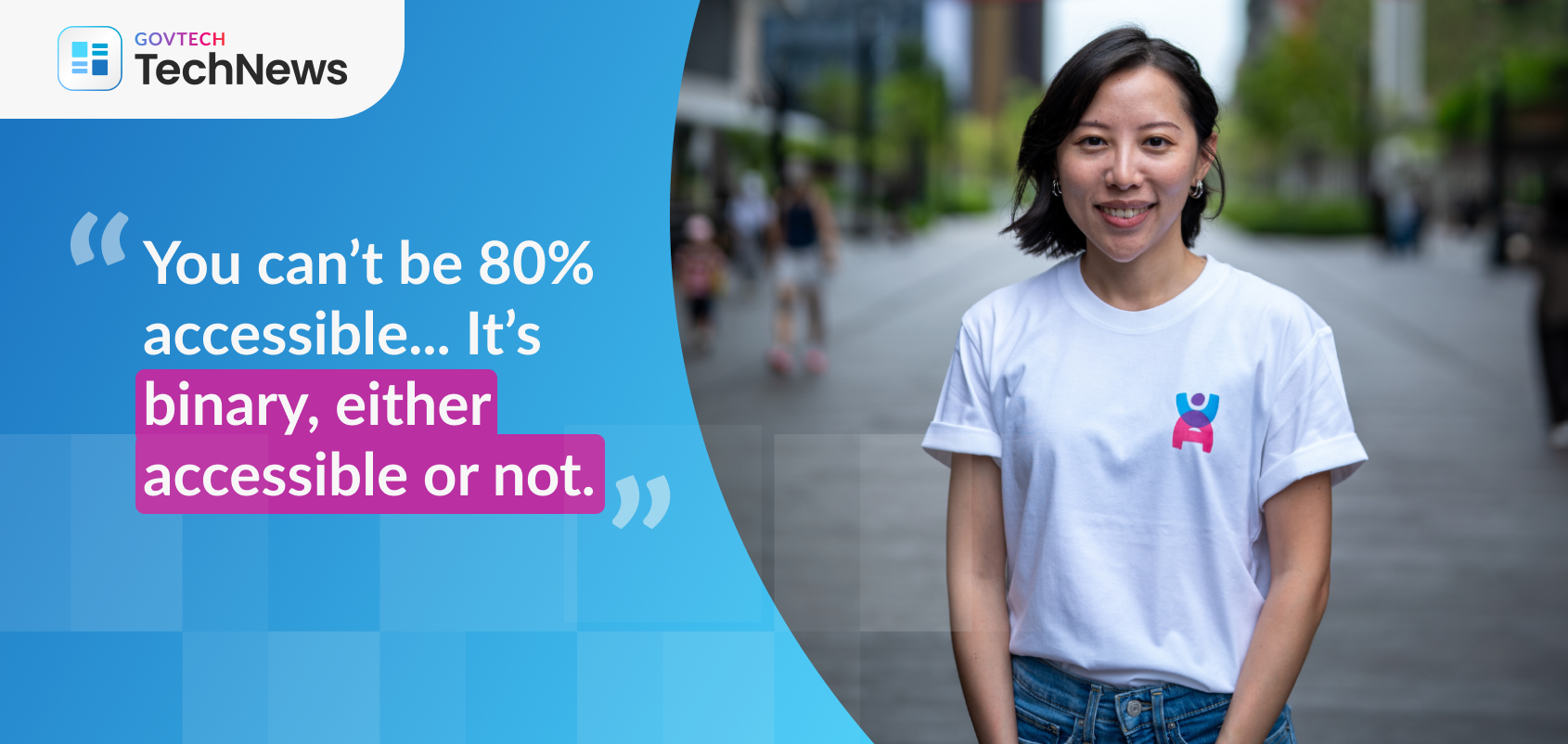
"You can't be 80% accessible.. It's binary, either accessible or not."
A statement like this tells you a lot about the person saying it. Joy's conviction comes through clearly in the way she talks about accessibility.
Whether discussing product design, testing or capability building, she consistently returns to the same principles: accessibility should be built in from the start, never compromised for speed, and never treated as a box-ticking exercise.
Meet Joy, Deputy Director and Principal Designer at GovTech, leading digital and social initiatives across MCCY's portfolio and driving Singapore's accessibility agenda under the Enabling Masterplan 2030 (opens in new tab) (EMP2030). This year, she's the winner of the Dare to Do Award at the Public Sector Transformation Awards 2026.
In this interview, Joy shares how she unexpectedly found her way into accessibility, the experiences that shaped her thinking, and why she remains steadfast in her belief that accessibility should never be treated as an afterthought. She also talks about leading a team of visually impaired accessibility testers, changing how agencies approach accessibility, and what it will take to build a truly inclusive digital government.
An unexpected path into accessibility
Accessibility was not, in fact, Joy's original specialisation. She had built her career in usability testing and recalled feeling apprehensive when her boss first assigned her the accessibility portfolio.
"As a UX practitioner, accessibility is basically baked into the DNA of what it means to build products with good user experience," she shared, explaining how she eventually grew into the role.
A light bulb moment in Vienna
A turning point came during the Zero Project Conference at the United Nations Office in Vienna. Conversations with accessibility experts convinced Joy that Persons with Disabilities (PwDs) should help shape accessibility goals directly rather than simply be consulted.
Inspired by what she learnt, Joy introduced a testing approach that pairs automated testing with manual testing carried out jointly by a PwD and an abled tester. This paired-approach catches issues that automated testing and checklists alone can miss.
"Digital service teams might brush off a request from me to fix an accessibility issue. But they think twice when it's a PwD user telling them directly," said Joy.
Accessibility starts from within the team
When Joy began considering hiring a visually-impaired officer to join her accessibility team at GovTech, she did not simply announce her decision.
"I wanted everyone genuinely on board, not just be told to accept it." said Joy.
Before making the hire, Joy worked through practical considerations such as workplace accommodations and team workflows. She also checked in with her team and even conducted an anonymous poll to ensure that her team would welcome the new colleague as an equal peer and not a checkbox hire.
Today, those considerations have become part of the team's everyday work. When approaching her visually impaired colleague, Joy identifies herself and lets him know whether she is on his left or right. During meetings where content is shared on-screen, the team joins a parallel Microsoft Teams call so he can follow along using his screen reader.
"Within the first month, our officer was already building presentation decks independently and setting up our manual accessibility testing service." said Joy.
For Joy, building accessible products starts with building an inclusive team. The everyday practices her team has adopted reflect the same principles she encourages agencies to apply when designing digital services.
Why "efficiency first" fails accessibility
For Joy, the stakes go beyond process.
.png)
Joy believes that the "efficiency first" mindset fundamentally misunderstands accessibility. Accessibility often gets deprioritised at the Minimum Viable Product stage in the name of efficiency, with teams adopting a "Ship first, fix later" approach.
However, her team flipped that logic, building accessible design systems from the outset and linters that automatically catch issues and suggest code fixes.
She stressed that “no amount of tooling replaces actual testing with persons with disabilities. That step can't be automated, and if you're purely optimising for efficiency, it's always the first thing to get cut."
Changing mindsets, not just building tools
One of the team's flagship initiatives, the A11y Playground (opens in new tab), was built in just one month to give public officers a hands-on way to experience accessibility.
"Honestly, the hardest part wasn't the building, it was getting the content right," Joy recalled.
She credits the effort to colleagues across communications, testing, design, and product management who temporarily stepped away from their own work to help bring the platform together.
"None of it would have happened without leaders who saw the value and were willing to lend us their people." Joy shared.
However, for Joy, the platform itself was never the end goal. Its real purpose was to change how agencies think about accessibility.
Joy explained that while Singapore's Digital Service Standards under IM8 (opens in new tab) establish an important baseline, she hopes agencies eventually build accessible services because they understand why accessibility matters, not simply because policy requires it.
What is IM8? In Singapore, government digital accessibility is governed by the Digital Service Standards (DSS), which are a mandatory component of the Instruction Manual for ICT&SS Management (IM8). These standards require all public sector digital services to comply with Web Content Accessibility Guidelines Levels A and AA, to ensure services are accessible to all users, including those with disabilities.
She sees that shift happening during the team's A11y Clinic sessions.
"Once they're in the room, you see the change. They start exploring the A11y Playground, asking genuine questions, and following along with the screen reader exercises," said Joy.
.png)
Recognition belongs to the team
While Joy is grateful for the recognition, she is quick to point out that the award reflects the work of many people.
“I just helped put the gears together, the team's the one that kept them turning." said Joy.
When asked about her proudest moment, Joy didn't point to progress towards Singapore's Enabling Masterplan 2030 (opens in new tab) (EMP2030) targets. Instead, she talks about the moments when accessibility becomes second nature to the people around her.
Whether it's spotting a townhall invitation without alt text or noticing that an internal digital service isn't accessible to a visually-impaired colleague, her team no longer waits for someone else to raise the issue. They speak up, work with their colleagues to fix it, and help make accessibility part of everyday practice across the organisation.
Looking beyond EMP2030
Looking ahead, Joy's focus isn't just on meeting Singapore's Enabling Masterplan 2030 (EMP2030) target of 100% accessibility, it is about sustaining that momentum well beyond it. Her team is currently pursuing what she describes as a "shift-left, shift-right" strategy: embedding accessibility into design systems and developer tools before products are built, while also creating intervention tools that help agencies identify and fix issues more easily after launch.
"The gears are in place, and we're on track for the EMP2030 target," said Joy but believes accessibility shouldn't stop at meeting a target.
"You can't be 80% accessible. It's binary, either accessible or not. If a digital service is 80% accessible, that one inaccessible button could be exactly the one that stops someone from completing a transaction." said Joy.
That's the principle Joy hopes will continue to shape the Government's approach to accessibility long after EMP2030 targets have been met.
Connect with us
Subscribe to the TechNews email newsletter (opens in new tab)
Join the Tech Kaki user-testing community (opens in new tab)