
Tech Education
Smart cities around the world: Amsterdam
15 January 2021
Learn about Amsterdam’s smart city technology efforts! Discover initiatives and projects tackling challenges in transport, carbon emissions, and more.
Smart cities have numerous benefits, including reducing wastage, saving on manpower costs, being environmentally sustainable, and of course, improving the lives of its citizens by making government services more accessible or efficient.
And if you didn’t already know, Singapore scores pretty well amongst the world’s smart cities. Singapore placed 9th in the 2024 IMD Smart City Index alongside other smart city superstars like Zurich, Oslo, Geneva, and Dubai.
But our journey doesn’t stop there...
We’re always looking for new ways to leverage technology to enhance urban living. And what better way to do so than by looking at our "competitors", or in other words, the other global cities in the smart cities league.
Amsterdam came in 17th in the same 2024 IMD Smart City Index, rising up one spot compared to the 2023 rankings. It received A and AA rankings across the index’s key criteria with higher scores than average in accessibility to medical services, employment opportunities, cultural activities, mobility, and residents’ feeling of safety.
Let's take a look at how Amsterdam does things in their smart city!
Fun fact: Apart from being amongst the world’s top smart cities, Amsterdam shares more than a few similarities with Singapore.
It was once a fishing village too.
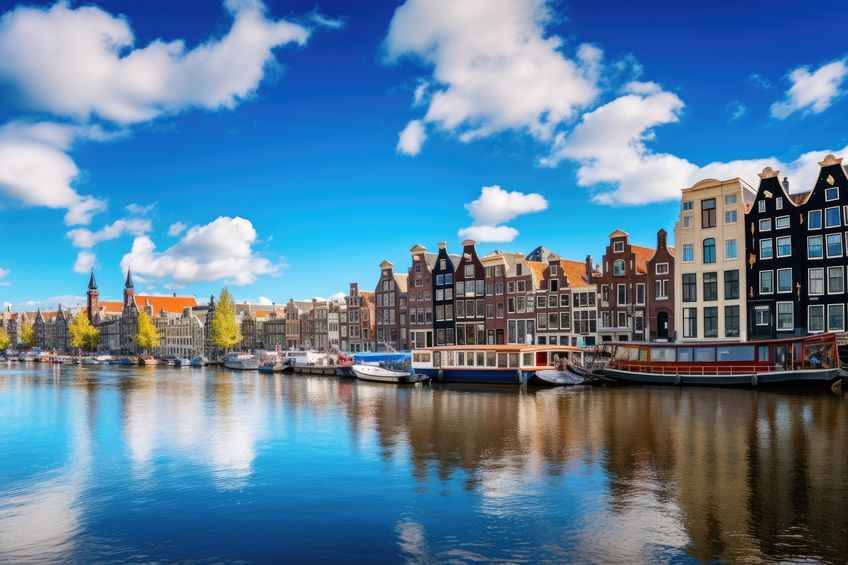
Though our urban landscapes differ, their colourful 17th-century low-rise historical buildings are somehow reminiscent of our Straits-Chinese shophouses, don't you think?
Introducing Amsterdam’s smart city platform
Formerly known as “Amsterdam Smart City”, “Amsterdam InChange” is a robust, open innovation platform that fosters collaboration between governments, education and cultural institutions, businesses, and social and civil organisations. It’s where citizens, startups, and institutions (both public and private) to work together and co-create urban solutions to the challenges they face. Over 240 online and offline projects have been showcased on the platform so far, falling across six key themes: Circular City, Energy, Mobility, Citizens & Living, Digital City, and Smart City Academy.
Amsterdam InChange shows us what a truly community-driven approach to smart city development could look like: a digital marketplace that turns ideas, connections, and innovative concepts into tangible projects that improve livability and economic prosperity.
Centralised forum for ideas and projects
A common roadblock in solving urban challenges is that someone may identify a challenge but not know who to reach out to to resolve the issue. Amsterdam InChange bridges that gap between city-dwellers, innovators, and potential partners.
An idea that starts with a single citizen can be presented to a wider network of experts who can help refine and implement it. This collaborative model ensures that urban challenges are tackled collectively and from multiple perspectives, leading to more holistic and effective outcomes. Through the smart city platform, problems can be verified and solutions can be troubleshot, ensuring a robust eventual solution.
Internet of Things (IoT) Living Lab
City Innovation Exchange Lab (CITIXL) is a public-private initiative in Amsterdam with the goal of gathering open-source and crowd-sourced urban data to help shape innovative smart city solutions. One of CITIXL’s key innovations are the 20+ IoT Living Labs located around the city. The labs utilise LoRaWAN, beacon, sensor, and G5 narrow band or NB-IoT networks to transmit small packets of data over distances of up to 3 kilometres using low-frequency radio signals.
This technology allows for constant, real-time data collection on various urban metrics, such as air quality, foot traffic, and water levels, without a heavy energy footprint. It provides a dynamic, real-world environment for testing new IoT solutions before they are scaled city-wide.
Amsterdam's ecosystem of smart city solutions
Enabling initiatives
Amsterdam’s smart city initiatives could not be achieved without a robust ICT infrastructure, such as its extensive open data platform that takes records from over 30 city departments and makes them freely accessible to the public. This empowers developers, researchers, and citizens to create their own independent technology-driven solutions.
Social initiatives
A notable smart city initiative with key social components is the Amsterdam Smart Citizens Lab, which empowers residents to use open-source hardware and software to monitor their local environment, such as air quality and noise levels. This direct involvement makes citizens active participants in shaping their city's future, enhancing their stake in Amsterdam’s urban makeup.
Another case study, which ran from February to mid-June 2024, was the True Price Lab. Launched at the Amsterdam University of Applied Sciences, this project invited university students and staff to choose between paying the regular or true price for selected products. This provoked questions and considerations about the hidden environmental and social costs of everyday goods, encouraging wider discussions about social inequality.
Mobility initiatives
Amsterdam is famous for its sustainable outlook, so it’s no surprise that its mobility-related smart city initiatives are geared towards reducing carbon emissions and greening its roads. One standout case study is the Zero Emission Urban Logistics Challenge, where a zero-emission zone was introduced in the city centre on 1 January 2025.
There’s also the Open Database of Bicycle Infrastructure Manuals, launched in 2022, which aims to collate and share 500+ cycling infrastructure documents within a single database: a truly useful resource for the world capital of cycling!
Circular city initiatives
Amsterdam’s bold goal of becoming a circular city by 2050 is supported by several innovative programs that promote sustainability and resource efficiency. Launched in 2016, Waste EcoSmart is a project that supports transnational research, knowledge sharing, and knowledge transfer to come up with effective waste management solutions.
We hope you've enjoyed learning about some of Amsterdam's smart city initiatives. While Singapore is blazing its own trail when it comes to smart city initiatives, looking at smart cities around the world and learning from their successes and challenges is a key part of our own smart city journey!
Explore other articles in this smart cities series:
Connect with us!

Subscribe to the TechNews email newsletter