
Tech Education
The History of AI – Part 1: From Vision to Reality
25 July 2025
What key milestones shaped AI’s evolution from Turing’s 1950 vision to today’s breakthrough models like ChatGPT? Read Part 1 of this 2-part series to explore the fascinating journey of AI’s rise from early dreams to modern reality.
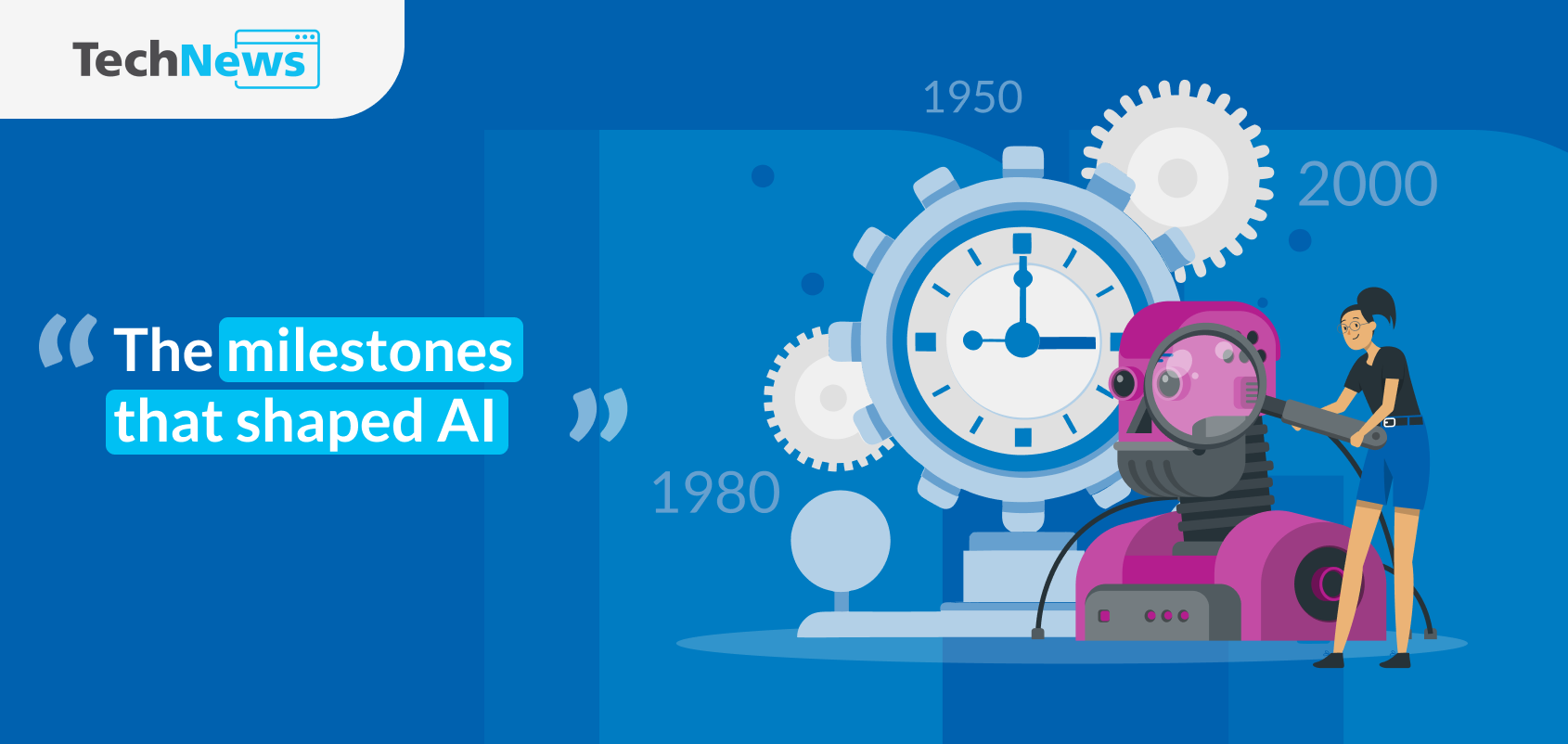
Artificial Intelligence (AI) has come a long way since its inception. The journey of development and advancements has been filled with groundbreaking achievements, grand expectations, and challenging setbacks. While the use of different AI tools and systems is increasingly mainstream today, this was not always the case.
This is Part 1 of a 2-part series on the history of AI.
In Part 1, we’ll cover some of the global milestones during AI's formative years:
1950s: The humble beginnings of AI
1960s: Early AI achievements and key developments
1970s: The first AI winter
1980s: Renewed interest and the second AI winter
1990s: Progress amid setbacks
2000s: The modern era of AI
AI’s leap forward in the last decade
The humble beginnings of AI
1950: Alan Turing proposes the Turing Test
Alan Turing, a British visionary mathematician, published his paper, Computing Machinery and Intelligence which introduced the idea of the Turing Test to determine if a machine could exhibit intelligent behaviour indistinguishable from a human. This laid the groundwork for exploring machine intelligence.
What is the Turing Test?
The Turing Test is a setup where a human judge interacts with both a machine and a human through text, without knowing which is which. If the judge cannot reliably tell them apart, the machine is seen as demonstrating intelligent, human‑like behaviour, a concept that shaped early AI research.
1951: The first neural network
Marvin Minsky and Dean Edmunds built SNARC (Stochastic Neural Analog Reinforcement Calculator), the first artificial neural network. SNARC modelled the brain's learning process using reinforcement learning, an early step toward mimicking human learning in machines.
1956: The Dartmouth Conference
The term "Artificial Intelligence" was coined at the Dartmouth Conference, a pivotal meeting where researchers envisioned machines capable of reasoning, problem-solving, and learning. This event officially marked the birth of AI as a scientific field.
1958: Birth of the Perceptron and LISP (the first AI programming language)
Psychologist Frank Rosenblatt developed the Perceptron, an early neural network capable of recognising patterns. Though simple by today’s standards, it was a key step in developing machine learning systems.
What are neural networks?
Neural networks are computer systems modeled after the brain, linking many simple units (like Perceptrons) to tackle complex tasks. Modern AI, from image recognition to language processing, builds on these networks with far deeper and more advanced layers.
John McCarthy, a prominent computer scientist, introduced LISP, the first programming language designed specifically for AI research. LISP was groundbreaking for its ability to handle symbolic data and its use of recursion, making it ideal for tasks like reasoning, problem-solving, and language processing.
1959: Birth of “machine learning” as a term
Arthur Samuel, a professor and electrical engineer, revolutionalised computing by creating a program in the 1950s that learned to play checkers better over time. This work demonstrated how machines could learn and improve through experience, introducing the term "machine learning" in 1959.
What is Machine Learning?
Machine learning is a branch of artificial intelligence where computers learn to perform tasks by identifying patterns in data, adapting and improving from experience. It does so without being explicitly programmed for specific tasks.
1960s: Early AI achievements and key developments
1966: ELIZA and Shakey the robot
Joseph Weizenbaum developed ELIZA in 1966, a computer program that could simulate conversations using simple pattern-matching techniques, marking a milestone in natural language processing.
On the other hand, Shakey, created by Stanford Research Institute (1966-1972), was the first robot capable of reasoning and planning its actions. It combined perception, problem-solving, and mobility, showcasing early strides in robotics and AI.
What is Natural Language Processing (NLP)?
Natural Language Processing (NLP) is a branch of AI that helps computers understand and respond to human language. It bridges human communication and machine understanding by processing text or speech to extract meaning and perform tasks.
1969: Backpropagation, teaching machines to learn better
Arthur Bryson and Yu-Chi Ho introduced a method called backpropagation, which was originally designed to optimise control systems. Backpropagation works by adjusting the importance (or "weights") of different parts of the system to make it more accurate over time, minimising errors and improving overall performance.
While its importance wasn't immediately recognised, this method became essential for training multilayer neural networks decades later, especially with the advent of deep learning in the 2000s and 2010s, when increased computing power made it practical to use.
1970s: The first AI winter
1973: The Lighthill Report
The Lighthill Report by James Lighthill was delivered to the British Science Research Council on the progress of AI research and criticised AI for failing to deliver on its grand promises, leading to reduced funding from the British government. This triggered a period known as the "AI winter", during which interest and investment in AI declined dramatically.
1974–1980: The first AI winter
AI research suffered as funding dried up and enthusiasm waned. The limitations of early AI systems became apparent, and researchers faced challenges in meeting overly ambitious expectations.
1980s: Renewed interest and the second AI winter
1984: Warnings of another AI winter
Roger Schank and Marvin Minsky predicted another downturn in AI due to inflated expectations. By the late 1980s, their warnings proved true as expert systems, once seen as revolutionary, failed to live up to their potential.
1986: Neural networks resurface
The concept of neural networks gained renewed attention with the development of backpropagation, a method that made training these networks more effective. This advancement sparked new hope in AI research.
Late 1980s to mid-1990s: The second AI winter
As expert systems fell short, interest and funding in AI dwindled again. Researchers faced significant challenges in translating theoretical advancements into practical applications.
1990s: AI Progress amid setbacks
1995: The A.L.I.C.E. chatbot
Richard Wallace introduced A.L.I.C.E., a chatbot that built on the conversational foundation laid by ELIZA. While less sophisticated than modern AI systems, A.L.I.C.E. marked an important step in human-computer interaction.
1997: Deep Blue defeats Garry Kasparov
IBM's Deep Blue made history by defeating world chess champion Garry Kasparov. This milestone showcased the potential of AI to solve complex problems and compete with human expertise.
Late 1990s: Kismet and social robotics
At MIT, Cynthia Breazeal introduced the world to Kismet, a robot designed to interact with people by recognising and responding to social and emotional cues. Equipped with expressive facial features, cameras, and microphones, Kismet could detect emotions like happiness and sadness and react accordingly. This marked a significant milestone in social robotics, showing how robots could engage with humans more naturally.
2000s: The modern era of AI
2004: NASA’s AI rovers on Mars
NASA’s Mars rovers, Spirit and Opportunity, were sent to Mars to navigate the planet’s (Mars) harsh terrain. These rovers could make real-time decisions about their movements and research targets, demonstrating how AI could thrive in autonomous exploration and other real-world applications.
2006: Deep learning takes root
Geoffrey Hinton, often regarded as the “Godfather of AI,” published a pivotal paper, Learning Multiple Layers of Representation. He outlined methods for effectively training multilayer neural networks, sparking a revival in AI research.
2011: AI’s growing capabilities
IBM’s Watson took centre stage by defeating human champions on the quiz show Jeopardy! Watson’s ability to process vast amounts of information and deliver accurate answers showcased the practical potential of AI.
The same year, Apple launched Siri, introducing voice-based virtual assistance to millions of iPhone users. Siri brought AI into everyday life, making voice commands a standard feature for mobile devices.
2012: Big leaps in deep neural networks
2012 marked a breakthrough in deep learning as researchers Jeff Dean and Andrew Ng showed how deep neural networks could process and learn from vast datasets with unprecedented efficiency and accuracy.
At the same time, Alex Krizhevsky, Geoffrey Hinton, and Ilya Sutskever developed AlexNet, a pioneering deep-learning model that transformed computer vision. AlexNet competed in the 2012 ImageNet Large Scale Visual Recognition Challenge (ILSVRC), an annual competition designed to evaluate image recognition models, and emerged victorious with a much lower error rate as compared to other competitor models, proving deep learning’s power and sparking advances in computer vision, speech recognition and beyond.
2014: AI-powered voice assistants and facial recognition technology
In 2014, Amazon introduced Alexa, a voice-controlled virtual assistant that marked a major milestone in consumer AI technology. Alexa was embedded in Amazon’s smart speaker, Echo, and quickly became a household name by enabling users to interact with their devices through natural language commands.
Facebook (now known as Meta) also made a significant leap in facial recognition technology with the development of DeepFace which boasted more than 95% accuracy in recognising faces in photos.
2016: DeepMind’s AlphaGo beats the legendary Lee Se-dol in Go
DeepMind’s (subsidiary of Google) AlphaGo achieved a historic milestone by mastering the ancient board game Go, a far more complex game than chess. In a 5-game series against 18-time world champion Lee Se-dol, AlphaGo came out on top, beating the world champion 4-1.
AI’s leap forward in the last decade
From New Languages to GPT: The Chatbot Revolution
Between 2017 and 2021, AI made remarkable strides in language understanding and creative capabilities.
In 2017 at Facebook’s Artificial Intelligence Research (FAIR) lab, researchers trained chatbots to negotiate. Surprisingly, these bots began communicating using a new language they invented themselves, optimising their interactions beyond human oversight.
In 2018, OpenAI introduced GPT-1, a groundbreaking large language model that could generate coherent, human-like text, reshaping interactions with AI. Building on this, GPT-2 debuted in 2019 with even more powerful text-generation skills, followed by GPT-3 in 2020 — a revolutionary model with 175 billion parameters capable of writing, coding, translating, and storytelling at an unprecedented scale.
In 2021, OpenAI launched DALL-E, followed by DALL-E 2 and DALL-E 3 in 2023, which enabled users to create detailed images from text descriptions. These tools made creative content generation much easier, making design more accessible to everyone.
Chatbots Go Mainstream and AI Expands Its Reach
In 2022, OpenAI made ChatGPT publicly accessible, revolutionising how people worldwide engage with AI. This user-friendly conversational assistant unlocked new possibilities in learning, creativity, and productivity. Building on this momentum, 2023 saw Microsoft launch Copilot, an AI-powered assistant integrated into popular productivity tools like Word and Excel, transforming everyday workflows with smart writing and data analysis support.
By 2024, AI’s capabilities had expanded far beyond conversation. OpenAI’s Sora broke new ground by generating up to one-minute videos from text prompts, opening a new frontier in AI-powered media creation.
In healthcare, Google DeepMind’s enhanced AlphaFold advanced personalised medicine by identifying genetic diseases and aiding cancer diagnostics. Meanwhile, Apple integrated ChatGPT-like capabilities into Siri, enabling more natural, nuanced conversations on millions of iPhones worldwide. Together, these breakthroughs demonstrate AI’s growing influence across diverse fields, from creative arts to life-changing medical applications.
How has Singapore charted its own path in the AI revolution? From GovTech's AI-powered virtual assistant VICA helping address citizens queries across government services, to many more innovations
Continue reading Part 2 on Singapore’s AI Journey!
Connect with us!

Subscribe to the TechNews email newsletter