
Why a scam may only reveal itself after several messages
16 November 2026
Category
Tech for Public Good
Digital Government
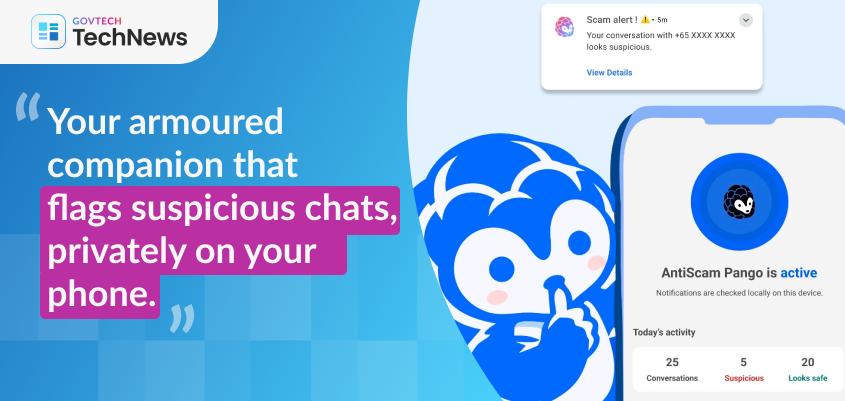
Explore how the AntiScam Pango team built an on-device app that looks beyond single messages to flag suspicious conversations.
Imagine receiving a message from an unfamiliar number.
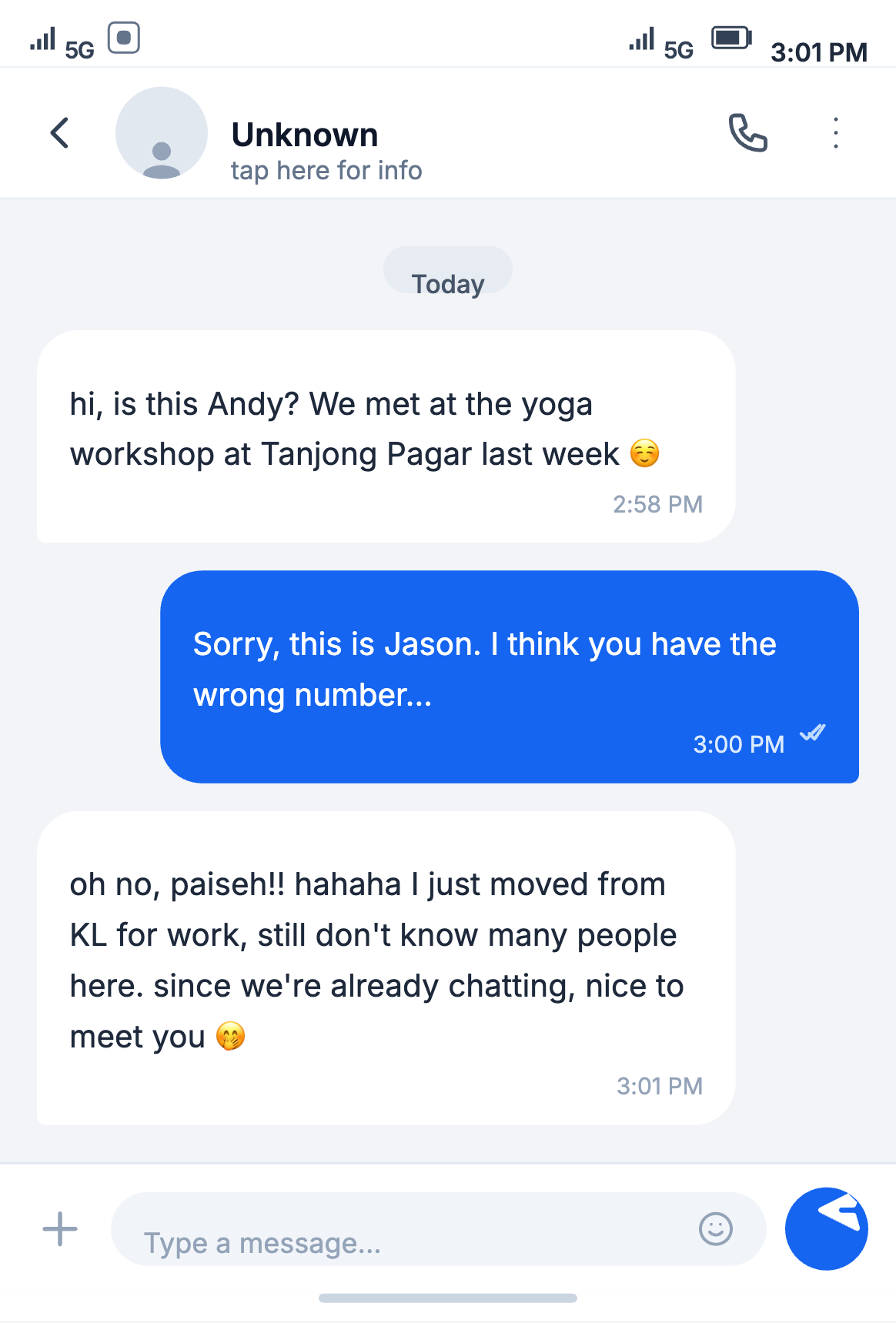
At first, there's nothing alarming about it. The sender might have contacted you by mistake, asked a normal question, or struck up a friendly conversation.
You exchange a few messages. The conversation continues. Perhaps the sender gradually earns your trust before introducing an investment opportunity, asking for personal information, or persuading you to do something you would otherwise question.
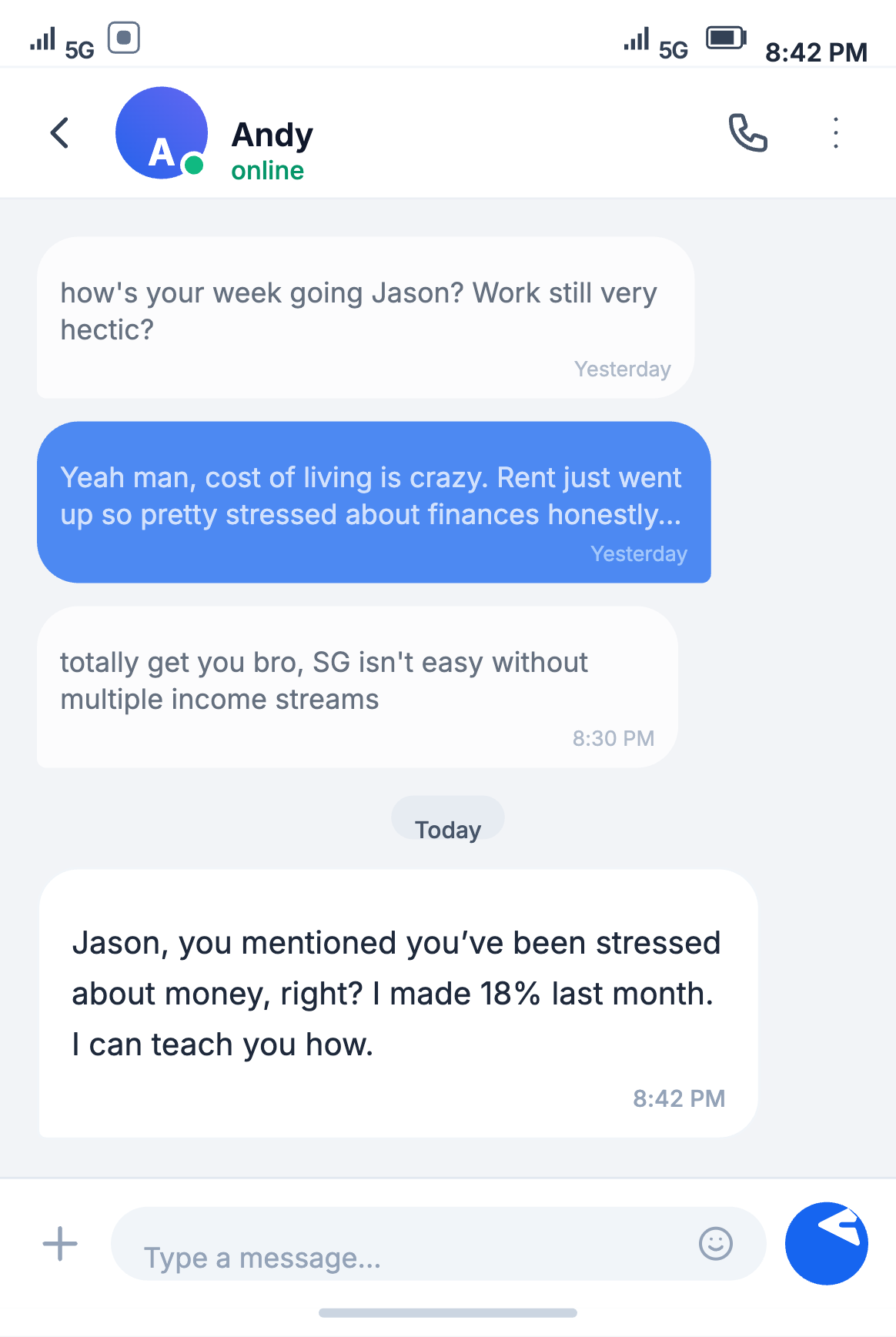
What seemed like a normal conversation has now taken a suspicious turn. No single message gives the scam away. Every message makes sense as a reply to the last, as after days of chatting, the sender no longer feels like a stranger. The warning signs only show when you look at how the conversation develops.
However, if the signs are not visible in the messages, how are users meant to spot them?
That is the challenge GovTech's new AntiScam Pango app aims to address. Instead of looking only at individual messages, it uses AI to spot suspicious patterns across the whole conversation, giving users a chance to pause and reconsider before responding.
When the warning signs are hidden in the conversation
Scams do not always begin with an obvious request for money or a suspicious link. Many rely on social engineering, gaining trust or creating urgency before steering the conversation towards the intended outcome. Viewed in isolation, each message may look harmless. Together, they reveal a pattern of manipulation.
The AntiScam Pango team groups conventional scam patterns into three types, each steering users towards a specific action:
Using authority: pretending to be a government official or a bank, then asking you to “verify” details or move money.
Leveraging trust: a friendly chat or a “wrong number” message that slowly leads to an investment, job or romance pitch.
Emphasising urgency: “your account will be frozen today,” or pressure to act before you can check with someone.
People naturally respond to the message in front of them without stepping back to assess the entire interaction. The warning signs are easy to miss in such situations because they only become clear across the whole conversation, and AntiScam Pango helps users spot them before they respond.
How AntiScam Pango connects the dots
Launched in beta by GovTech Singapore on 4 November 2026, AntiScam Pango is an AI-powered mobile app designed to help users identify suspicious conversations across supported messaging platforms.
Once installed and the necessary permissions are granted, AntiScam Pango runs in the background, analysing incoming message notifications from WhatsApp, Telegram, and SMS.
Rather than treating messages separately, AntiScam Pango groups those from the same sender into a conversation and looks for characteristics commonly associated with scams, including in messages from numbers that have not been flagged before.
In simple terms, the team explains, each new message gets a quick check on the phone. If something looks off, AntiScam Pango takes a closer look at the recent conversation. It watches for shifts: a stranger moving from small talk to money, pressure to act quickly, or a request for an OTP or personal details.
 - Simple mode [Light].png)
When AntiScam Pango flags a suspicious conversation, it sends an alert to the user. Importantly, the alert does not simply label the conversation as a scam.
AntiScam Pango does not block, delete or respond to messages, so users stay in control of whether to continue, verify the sender independently, or report it.
But what about your private messages?
For an app that analyses conversations, an obvious question arises: what happens to the messages it reads?
After all, messaging apps are where people share personal conversations with family, friends and colleagues. Protecting users from scams should not come at the expense of their privacy.
AntiScam Pango addresses this through on-device AI processing. Instead of sending messages to an external server for analysis, AntiScam Pango processes message notifications entirely on the user’s phone.
This means users' private conversations do not need to be uploaded to the cloud for scam detection.
Neither GovTech nor its technology partners can access users' private messages through the app. A message, and the sender’s number or handle, only leave the phone if the user chooses to report it.
.png)
Users see exactly what will be sent before confirming, and the app masks any NRIC number. Reports also include a pseudonymous install ID (a random identifier that cannot be traced back to you personally).
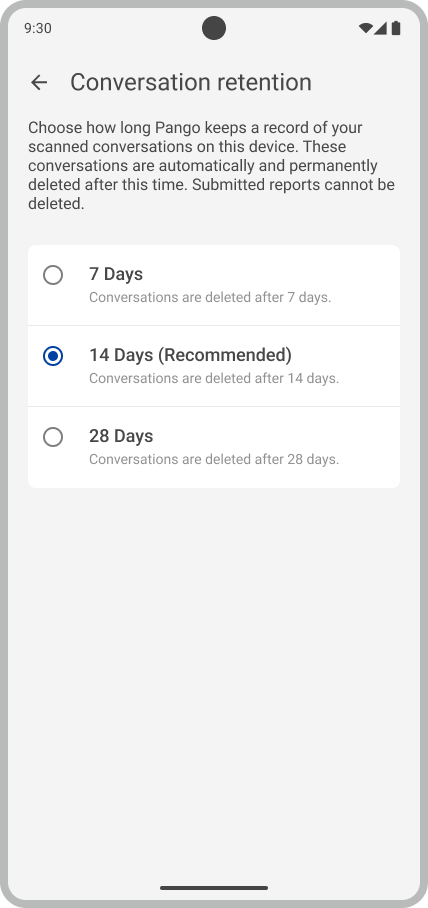
In Settings, users can choose how long messages are kept (Message retention) and erase their history (Clear app history), with the default retention period being 14 days long. Anonymous analytics (“Help Pango learn”) is a separate setting and excludes message content.
As Mark Chen, Director of Trust and Safety at GovTech Singapore, explained:
"With AntiScam Pango, we want to show people that they do not have to choose between protection from scams and keeping their personal messages private. Our collaboration with Google DeepMind is pushing the boundaries of what small AI models can do to deliver both."
Kelly Ng, the product manager of AntiScam Pango further explains why on-device processing was a core requirement from the beginning.
.png)
When public-sector knowledge meets private-sector AI expertise
Building AntiScam Pango took more than an off-the-shelf AI model. The model had to learn to recognise the scams that target Singaporeans, and how they can unfold across seemingly ordinary conversations.
To bring these capabilities together, GovTech collaborated with Google DeepMind, combining GovTech’s knowledge of Singapore's scam landscape with Google's DeepMind expertise. In building small AI models that run efficiently on mobile devices.
According to Google DeepMind's official blog (opens in new tab), published on 14 October 2026, the teams fine-tuned Google's Gemma AI model to recognise locally relevant scam patterns. They also developed a two-stage approach that first screens incoming messages for potential threats before conducting more detailed analysis of suspicious conversations.
The collaboration shows how public-sector knowledge of local scam patterns and private-sector AI expertise can come together to tackle a real-world problem, while keeping users' private conversations on their devices.
For GovTech, AntiScam Pango is also an opportunity to explore further collaborations with technology and industry partners to strengthen scam detection capabilities.
“Scammers don’t stick to one platform, and neither should protection. We welcome partners who can help bring on-device scam detection to more devices and messaging apps, and help it understand more of the languages Singaporeans actually use,” the AntiScam Pango team shares.
A warning, not a verdict
AI is not perfect and a legitimate conversation may occasionally be flagged, while some scams may go undetected. AntiScam Pango also depends on the message notifications it can access, and cannot analyse a message if no notification is generated or its content is unavailable. Alerts should be treated as prompts for caution, not definitive judgements, and the absence of an alert does not mean a conversation is safe. AntiScam Pango is currently in beta for Android users, and the team is exploring ways to extend similar privacy-preserving detection to iOS and additional messaging platforms.
Another layer of protection against scams
AntiScam Pango is not intended to replace existing anti-scam tools.
AntiScam Pango complements ScamShield (opens in new tab), which helps users block scam calls, filter suspicious SMS messages, and check or report fraudulent messages, phone numbers and links. ScamShield blocks calls and filters SMS from numbers already reported as scams. But a scammer using a brand-new WhatsApp number won’t be on any list yet. If that chat slowly turns into an investment pitch, AntiScam Pango can flag it. Using both covers known new numbers.
Ultimately, the most important response to a suspicious conversation remains the same: pause before acting.
If a message raises concerns, avoid clicking unfamiliar links, sharing sensitive information, or transferring money. Verify the sender's identity through an independent, trusted channel rather than relying on contact details provided in the conversation.
Users who are unsure can also seek advice through ScamShield's 24/7 helpline at 1799. (opens in new tab)
As scam tactics become more sophisticated, the clearest warning may not be found in any single message, but in the story that unfolds across them. The team hopes AntiScam Pango helps people recognise that story sooner. The goal comes down to one small habit.
“If AntiScam Pango gets people to stop for ten seconds and ask, ‘wait, does this make sense?’, it has done its job. That pause, to check with someone you trust or call 1799, is often all it takes,” as the team shares their eventual goal.
Find out more about AntiScam Pango at pango.gov.sg (opens in new tab). The beta app is available for Android users through the Google Play Store.