
AfterLifeSG: How a hackathon idea became Singapore's first digital memorial service
8 October 2026
Category
Tech for Public Good
Digital Government
Learn how a prototype from GovTech’s inaugural {build} hackathon grew into AfterLifeSG, a digital memorial service now open to the public.
Memories rarely live in one place.
They sit in old photo albums, phone galleries, family group chats, half-remembered stories, and the minds of people who knew someone well. When a loved one passes on, gathering those memories can become difficult, especially when families are also navigating intense grief and the logistics of someone passing.
AfterLifeSG helps users create digital memorials where family and friends can remember a loved one through shared photographs, biographies, resting place information, flowers, and memories. That was the space AfterLifeSG (opens in new tab) began exploring: how might families preserve stories, photos, and memories of loved ones in a way that feels respectful, accessible, and trusted?
The service did not originate from a policy. It started as a ground-up prototype at GovTech’s inaugural {build} hackathon in March 2025 (opens in new tab).
Its journey from hackathon idea to public launch shows what it takes to turn an unconventional public-sector idea into a real digital service, especially when the subject is as personal as remembrance.
Recognising a gap in how Singapore remembers
The idea began with a gap in the remembrance experience. Liau Wen Rui, the product manager who led the hackathon team, observed how difficult visits to remembrance sites could be, with Qing Ming visits in the heat and families unsure where their loved one's columbarium niche was.
Day to day, photos and stories were also scattered across family members, devices, and group chats, with no central space to keep a person's memories together.
Singapore also faces a larger challenge. The island is land-scarce, yet traditional forms of remembrance require physical space. An ageing population and a rising number of deaths each year all add to that pressure.
These all pointed to a bigger need that is universal, deeply personal, and relatively unexplored by digital services: helping people remember and stay connected to loved ones who have passed, while making remembrance less dependent on physical space.
AfterLifeSG was the team's answer to building a platform where families could keep a person's memories together, without needing a physical space to do it,, with a vision to become a trusted and sustainable remembrance platform for Singaporeans.
Shaping the first prototype at {build}
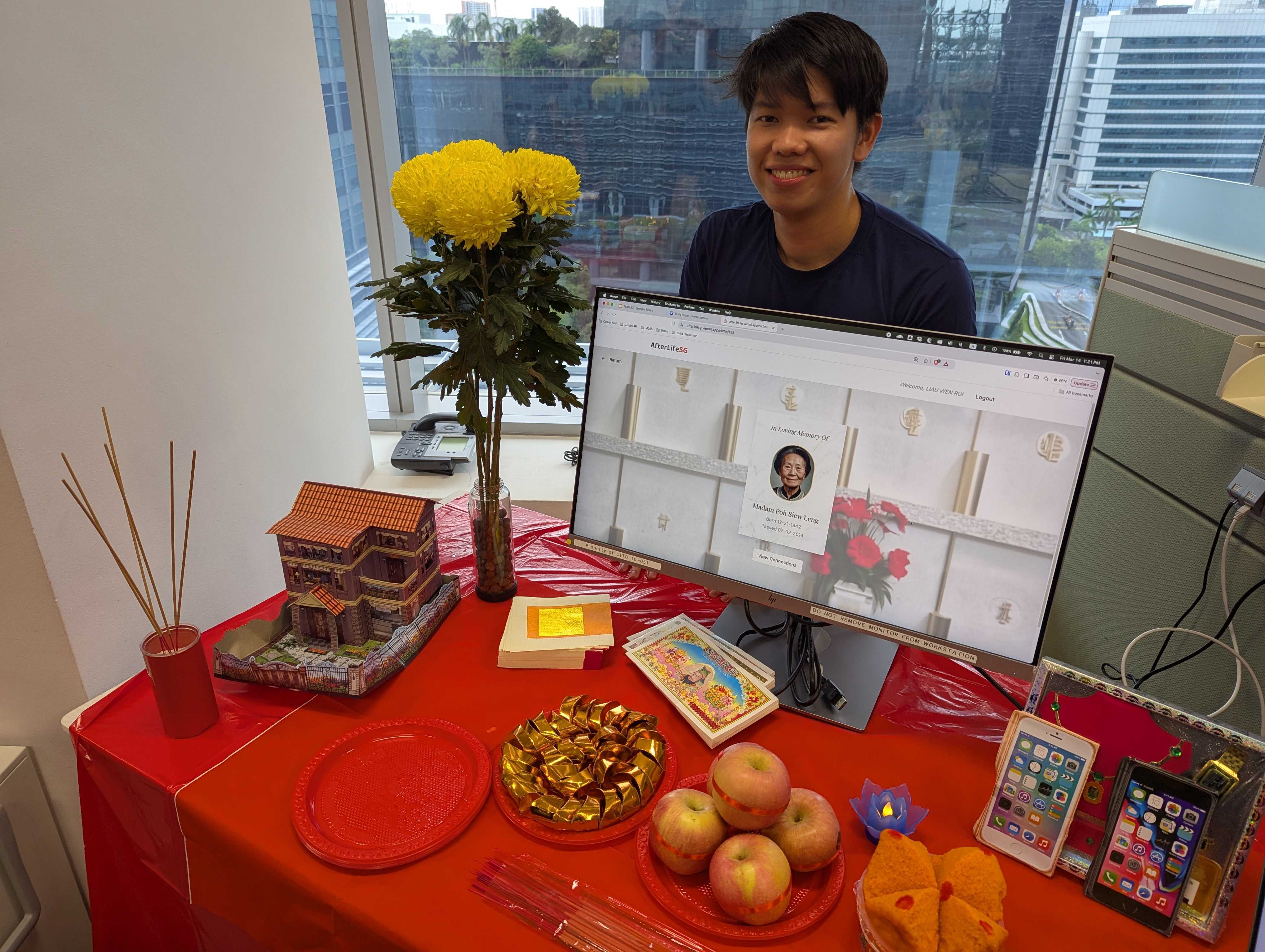
AfterLifeSG's {build} hackathon booth to showcase the prototype
{build} gave the team room to explore the problem quickly and creatively, without waiting for an agency brief. During the hackathon, they built a prototype digital memorial with a biography, resting place information, and photos contributed by family and friends. It also included an early AI concept that lets users interact with a simulation of the deceased, based on their biography and shared memories.
The prototype won the Judges' Choice award and was selected for incubation. But what convinced the team to keep going was how relatable the idea was, as it reminded many who saw the prototype of their own families and experiences.
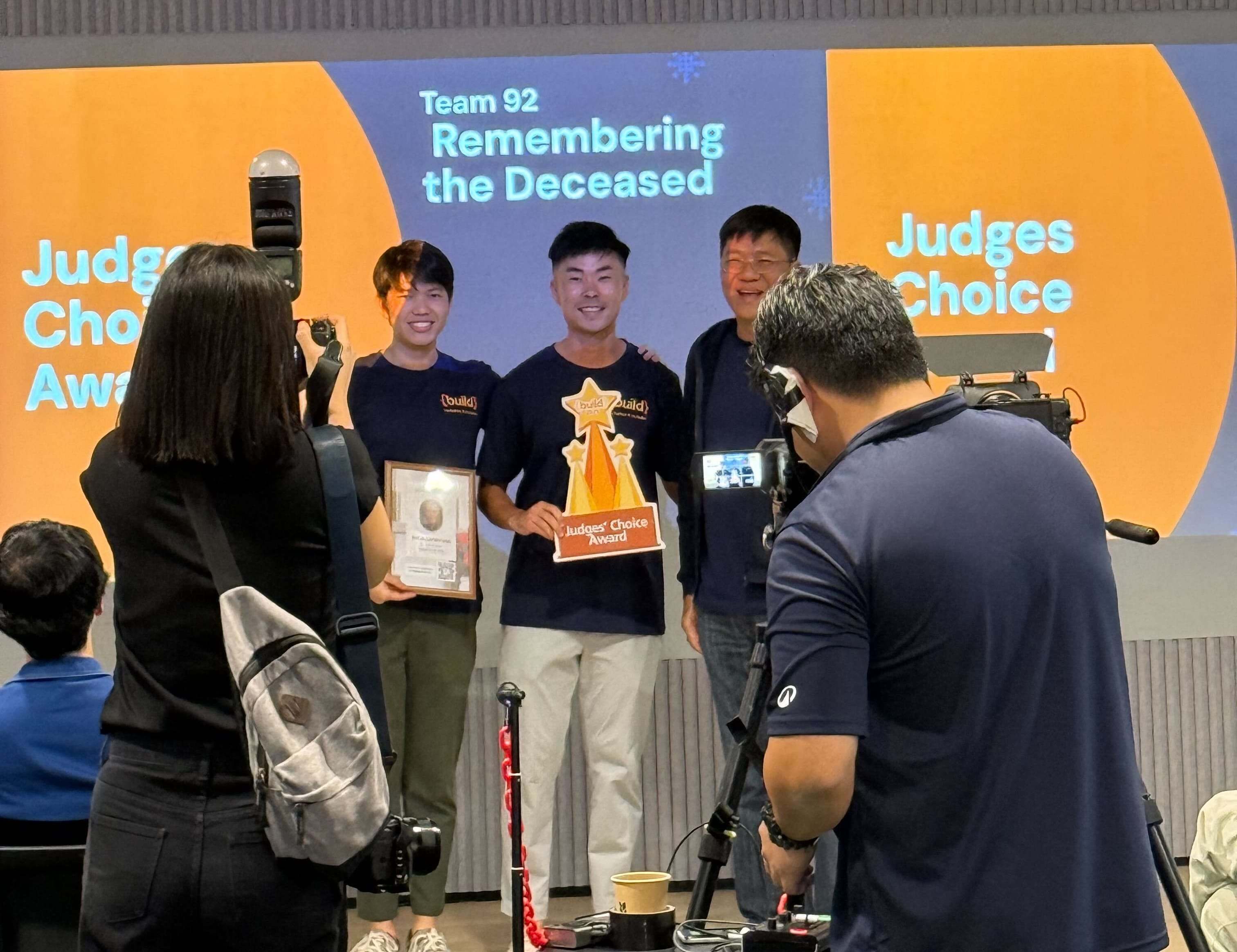
AfterLifeSG team winning the Judges' Choice award at {build} hackathon
Feedback from judges and colleagues also raised questions about privacy, the appropriate use of AI, and the right tone for a government remembrance service. These questions would shape how the team developed AfterLifeSG beyond the prototype. Given the sensitivity of the AI simulation concept in particular, the team decided to set it aside for the public launch, choosing to focus first on the core memorial experience before revisiting more experimental features.
Building with what was on hand
The team started with what GovTech could offer. Incubation support from GovTech's Tech Management Office, now the GovTech Innovation Office, included initial funding for user research. In April 2025, Wen Rui brought in design lead Arthur Lee and engineering lead Ellie Yee. The small team worked on AfterLifeSG alongside their day jobs, with help from members of the original hackathon team. Their first goal was a controlled launch to public officers, to prove the service's value and build a case for funding.
With limited time, they made the most of the tools available. Product and design aligned on medium-fidelity sketches instead of pixel-perfect designs, and the UX designer refined the front-end directly in code using AI-assisted tools.
They were equally careful to promise only what the system could deliver. Rather than calling memorials "private", the first release offered "unlisted" memorials, accessible only by link, to reflect what the system could guarantee at the time.
With minimal marketing, the team relied on GovTech's existing channels to drive initial awareness. AfterLifeSG launched to public officers in September 2025, rolling out progressively through organic contacts, GovTech staff, Smart Nation Ambassadors (opens in new tab) (GovTech’s community of citizen testers, formerly known as Tech Kaki), and the whole of government, using only emails and messages on a work communication platform. Public officers could create memorials, while members of the public could contribute to published ones. The trial tested various aspects of the service such as adoption, usability, trust, tone, privacy expectations, and public perception.
Even with such limited publicity, the trial drew 5,301 visitors, with 73 memorials published and 201 flowers and 225 memories shared between August and September 2025, marking a promising start for the service.
Grounding the service with NEA
The National Environment Agency (NEA) (opens in new tab), which manages public columbaria, cemeteries, and inland ash scattering facilities, was the natural agency partner. The team rallied support at multiple levels of the agency. A key moment came when Wen Rui demonstrated the prototype to NEA's Chief Executive Officer at the Digital Leaders Forum (opens in new tab), which connected the team with the right officers at the working level.
Working with NEA meant thinking beyond technology to regulations, public expectations, and operational realities. When an early meeting showed that the GovTech and NEA teams might not be fully aligned, the AfterLifeSG team roped an NEA colleague into the core product team to improve coordination.
As AfterLifeSG was incubated at GovTech, NEA could explore the idea alongside the team from an early stage. The partnership also made the land scarcity problem more concrete and broadened the team's view of what AfterLifeSG could do beyond memorials.
Designing with care as the key priority
Most digital products are designed for speed and efficiency. AfterLifeSG had to be designed for people who are grieving, where every interaction and feature in the service had to be both intentional and emotionally appropriate. The team paid close attention to pacing, wording, when to prompt users, and how much information to ask for.
With Singapore's mix of religions, cultures, and remembrance practices, the team also realised that there was no fixed way to remember someone. The joss sticks and candle offerings in the hackathon prototype were replaced with flowers that users can leave on a memorial, keeping the service religiously agnostic. The platform’s visual style draws on calm, natural imagery so that the focus stays on life, memories, and people.
Preparing for a wider audience
After the pilot met its targets, the team secured funding, with support from NEA stakeholders, to grow AfterLifeSG from a trial into a full product. Messages from pilot users about how meaningful the service was also what gave the team the confidence to go further.
A public launch also meant higher expectations for security and trust. The team moved sign-in to Singpass, GovTech's national digital identity, and added death certificate verification to prevent falsified memorials, along with password protection to give families more control over who can view a memorial. Prior to the public launch, the service also went through security testing and clearance, to be able to be scaled to handle much larger volumes of photos and memories.
And finally, AfterLifeSG was launched to the public in July 2026.
Nurturing a ground-up idea at GovTech
Parts of AfterLifeSG's journey could have happened elsewhere, but working within GovTech shaped how it developed. The idea could start as a ground-up hackathon project, and the team could experiment before an agency brief was fully defined. Incubation funding let work begin early, and the team could draw on colleagues' expertise in design, engineering, security, and marketing.
At the same time, working within GovTech meant meeting government standards before going public, including security testing, compliance clearance, and sign-off from leadership. AfterLifeSG needed both that room to experiment and that accountability to reach the public.
Applying the lessons from AfterLifeSG’s journey
"A hackathon prototype is not a smaller version of the final product," Wen Rui shares. "The real work begins after the hackathon."
That work is not simply about adding more features. For teams hoping to move an idea beyond a hackathon, AfterLifeSG's journey offers three key lessons on what it involves:
Build the team before the funding. Recruit the right people before funding is confirmed, then secure the budget to continue.
Align partners and direction early. Build agency support, align with the agency's digital team, and agree on the product's future vision and roadmap.
Plan the launch, not just the product. Define a go-to-market plan early, narrow the simplest version of the product that is suitable for release, and complete security and compliance work.
Looking ahead to a fuller remembrance journey
AfterLifeSG helps preserve memories after someone is gone, but it also encourages people to preserve those connections while their loved ones are still here.
The team now plans to broaden AfterLifeSG into a fuller remembrance journey, including guidance on what to do after a death, expressing final wishes, and stronger links between physical and digital remembrance.
What began as a ground-up idea at a hackathon is now a service that the public can readily use, made possible by room to experiment and a supportive environment to see it through. AfterLifeSG is available for the public to use. (opens in new tab)
The next idea could come from anyone in the public service. Have an idea for a better public service? Find out more about GovTech’s annual {build} (opens in new tab) hackathon and kickstart your innovation journey!